Ever noticed that your March salary has a higher Tax Deducted at Source (TDS) than in previous months?
It may not be a payroll error.
In India, employers generally calculate salary TDS based on an estimate of an employee’s taxable salary and tax liability for the entire financial year. As the financial year approaches its end, payroll teams review the tax already deducted and adjust the remaining deductions to account for the estimated annual tax liability.
If less tax has been deducted during the earlier months, the remaining amount may need to be recovered through higher TDS in March.
In simple terms, higher TDS in March often means your employer is adjusting the tax deducted throughout the year to align it with your estimated annual income tax liability. However, the actual reason depends on your salary, tax declarations, income details, and deductions considered by your employer.
What Is TDS on Salary?
Tax Deducted at Source (TDS) is the income tax deducted by an employer from an employee’s salary and deposited with the government, as required under applicable tax rules.
Under Section 192 of India’s Income-tax Act, employers generally calculate salary TDS based on the estimated salary income and applicable tax liability for the financial year.
The calculation may take into account:
Estimated annual salary and taxable allowances.
Bonuses, incentives, and variable pay.
Taxable perquisites and benefits.
Eligible deductions and exemptions, where applicable.
The tax regime selected or applicable to the employee.
Income reported from a previous employer.
TDS already deducted during the financial year.
Because these factors can change during the year, the amount deducted every month may not always be the same.
6 Reasons Why Your TDS May Be Higher in March
1. Tax Was Under-Deducted in Previous Months
One of the most common reasons for higher March TDS is that the tax deducted earlier in the financial year was lower than the amount required based on the latest annual tax estimate.
Employers generally consider the tax already deducted and adjust subsequent deductions to account for the estimated annual liability.
Example:
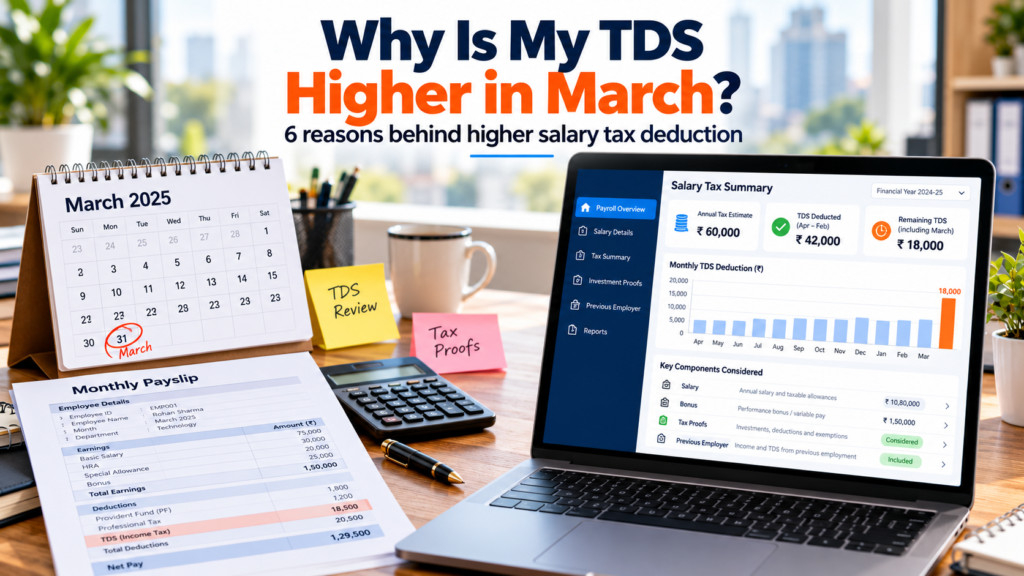
Suppose your employer estimates your total annual income tax liability at ₹60,000. By the end of February, only ₹42,000 has been deducted.
The remaining amount is ₹18,000.
If the employer needs to deduct the entire remaining amount in March, your March TDS could be ₹18,000, assuming no further adjustments.
| Particulars | Amount |
|---|---|
| Estimated annual income tax liability | ₹60,000 |
| TDS deducted from April to February | ₹42,000 |
| Illustrative remaining TDS for March | ₹18,000 |
This example is for illustration only. The actual monthly deduction depends on the employer’s calculation, remaining payroll opportunities, and applicable tax rules.
2. Salary Revision During the Financial Year
A salary increment or salary revision can increase your estimated annual taxable income.
When your salary increases, your employer may need to recalculate your projected annual income and revise the TDS deductions accordingly.
For example, if your salary increases during the year, the additional salary earned may increase your estimated tax liability. If the revised estimate is considered late in the financial year, the remaining TDS may be distributed across the remaining payroll months, including March.
A retroactive salary revision may also create arrears, which can affect the annual salary estimate and tax calculation.
3. Bonus or Variable Pay
Performance bonuses, incentives, commissions, and other variable payments can increase your taxable salary.
If you receive a bonus near the end of the financial year, your employer may need to update your annual income estimate and calculate the additional tax that should be deducted.
This can make your March payslip show a higher TDS amount than usual.
The increase may reflect the tax impact of additional income rather than an error in payroll processing.
4. Changes in Investment Declarations or Tax Deductions
Your tax deductions and exemptions can influence the amount of TDS deducted from your salary, depending on the applicable tax regime and eligibility requirements.
For example, if you previously declared eligible investments or expenses but do not provide the required supporting documents when requested, your employer may revise the deductions or exemptions considered in the payroll tax calculation.
This can increase your estimated taxable income and the TDS required for the remaining months.
Employees should review their tax declarations, submitted proofs, and employer communications before concluding that a higher March deduction is incorrect.
5. Income from a Previous Employer
If you changed jobs during the financial year, your current employer may need to consider salary income and TDS details from your previous employer when calculating your annual tax liability, subject to the applicable rules and information provided.
If previous employment income or TDS details were not included in the earlier estimates, the revised calculation may increase the tax due through your current employer’s payroll.
This is why employees who switch jobs should provide accurate previous-employer salary and tax deduction information to their current employer when required.
6. Taxable Perquisites and Other Income Adjustments
Certain employer-provided benefits and perquisites may be taxable under applicable income tax rules.
Examples can include specified accommodation benefits, certain allowances or reimbursements, and other taxable employment-related benefits, depending on the circumstances.
If taxable benefits are added to your annual income estimate later in the year, your employer may need to adjust TDS accordingly.
Other corrections to estimated salary income or tax calculations can also contribute to higher year-end deductions.
Does Higher TDS in March Mean You Are Paying More Tax?
No. Higher TDS in March does not necessarily mean your annual income tax liability has increased.
It is important to distinguish between your total annual tax liability and the timing of tax deductions from your salary.
Your annual tax liability is calculated based on your taxable income, applicable tax regime, eligible deductions or exemptions, and the tax rules for the relevant financial year.
TDS is the amount withheld during the year toward that liability.
If less tax was deducted in earlier months, a larger amount may be deducted in March to bring the total TDS closer to the estimated annual tax liability.
However, your annual tax liability may also genuinely increase if your income rises or your eligible deductions or exemptions change.
Therefore, a higher March TDS may reflect a timing adjustment, a change in estimated tax liability, or a combination of both.
How to Check Whether Your March TDS Is Correct
If your March salary shows a higher tax deduction, review the following before assuming there is a payroll error.
Step 1: Check your annual salary estimate. Review your total salary, bonus, incentives, arrears, and other taxable components for the financial year.
Step 2: Review TDS deducted so far. Compare the tax deducted from April through February with the amount shown in your payslips and available tax records.
Step 3: Verify your tax declarations. Check whether your employer has considered the applicable declarations, supporting documents, deductions, and exemptions.
Step 4: Confirm previous-employer income. If you changed jobs during the year, verify that the relevant salary and TDS details have been considered correctly.
Step 5: Ask payroll for the calculation. Request a breakdown of the estimated annual tax liability, TDS already deducted, and remaining tax deduction.
Step 6: Review your tax records. Check your Form 16 when available and compare the reported TDS with the relevant records, such as Form 26AS and the Annual Information Statement (AIS), where applicable.
If you identify a discrepancy, contact your HR or payroll team to understand the calculation and request a correction where necessary.
How HR and Payroll Teams Can Reduce March TDS Surprises
A sudden increase in March TDS can create confusion for employees and increase payroll queries at the end of the financial year.
Organizations can reduce these issues by implementing a structured year-end tax review.
Recommended practices include:
Reviewing estimated annual taxable income throughout the financial year.
Updating salary estimates after increments, bonuses, and other compensation changes.
Collecting previous-employer income and TDS details where applicable.
Communicating tax declaration and proof submission deadlines clearly.
Reviewing eligible deductions and exemptions under the applicable tax regime.
Monitoring the difference between estimated annual tax liability and TDS already deducted.
Explaining significant changes in monthly TDS to employees.
Validating final payroll calculations before processing March salaries.
Regular reviews help employers identify potential shortfalls earlier and reduce the need for large last-minute deductions.
For employees, transparent communication can make year-end tax adjustments easier to understand and plan for.
Frequently Asked Questions About Higher TDS in March
Why is my TDS suddenly higher in March?
Your TDS may be higher in March because your employer is adjusting the tax deducted during earlier months to align it with your estimated annual income tax liability. Salary revisions, bonuses, missing tax proofs, previous-employer income, or other taxable income adjustments may also contribute.
Is higher TDS in March a payroll error?
Not necessarily. A higher deduction may be a valid year-end tax adjustment. However, if your annual income estimate, deductions, or previous TDS figures are incorrect, the calculation may need to be reviewed by your payroll team.
Can my employer deduct more TDS in March to cover earlier months?
Employers generally calculate and deduct salary TDS based on the estimated annual tax liability under the applicable rules. Where earlier deductions are insufficient, the remaining amount may be adjusted through later salary payments, subject to the relevant requirements and payroll circumstances.
Will I get a tax refund if too much TDS is deducted?
If your total eligible tax payments and TDS exceed your final income tax liability, you may be eligible for a refund after filing your income tax return and completing the applicable assessment process.
Does a salary increment increase March TDS?
It can. A salary increment may increase your estimated annual taxable income and tax liability. If the revision is considered late in the financial year, the additional TDS requirement may be reflected in the remaining payroll months.
Does a bonus increase salary TDS?
A taxable bonus can increase your estimated annual salary income and may result in additional TDS. The actual impact depends on your overall income, applicable tax regime, and the employer’s tax calculation.
How can I check my total TDS for the financial year?
You can review your monthly payslips, the TDS details available through your employer, Form 16 when issued, and relevant tax records such as Form 26AS. Compare the amounts with the tax liability calculated under the applicable rules.
Can I ask HR why my March salary is lower?
Yes. You can request a breakdown of your March TDS calculation, including estimated annual taxable income, tax already deducted, applicable deductions or exemptions, and the remaining tax amount. This helps you understand whether the change is an expected adjustment or a discrepancy that needs correction.
Conclusion: March Payroll Deserves a Closer Look
A higher TDS deduction in March can be surprising, especially when your take-home salary is lower than expected.
However, the increase does not automatically indicate a payroll mistake or a higher annual tax liability. It may simply reflect an adjustment to ensure that the tax deducted during the financial year aligns with your estimated annual income tax liability.
Employees should review their salary details, tax declarations, and previous deductions, while HR and payroll teams should communicate year-end tax adjustments clearly.
Understanding your March TDS helps you plan your finances better and approach year-end payroll with greater confidence.
At Savi3 HR, we understand the importance of accurate payroll calculations, transparent processes, and compliance-focused operations. Our HR, payroll, accounting, and compliance services help businesses manage essential payroll processes more effectively.
Visit savi3hr.in to learn more about our services.