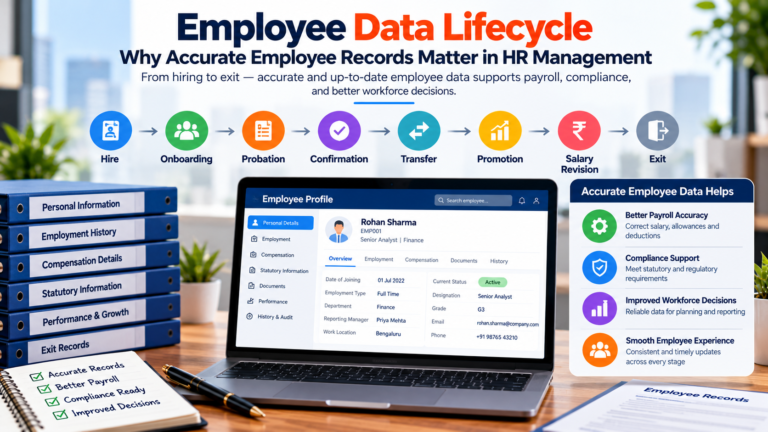
Employee data doesn’t stop at onboarding. It evolves throughout an employee’s journey, from hiring and onboarding to promotions, salary revisions, transfers, and exit.
The employee data lifecycle refers to the process of creating, maintaining, updating, and managing employee information at every stage of employment. Keeping these records accurate and up to date helps organizations improve HR operations, maintain reliable payroll data, support better workforce decisions, and manage compliance requirements effectively.
For businesses, maintaining accurate and effective-dated employee records is essential because every employee change can impact multiple HR processes.
What Is the Employee Data Lifecycle?
The employee data lifecycle is the complete journey of employee information within an organization, from recruitment and hiring through employment changes to separation.
As employees move through different stages, their information may need to be updated in HR systems, payroll records, attendance systems, benefits administration, and compliance documentation.
A typical employee data lifecycle includes:
Hire → Onboarding → Probation → Confirmation → Transfer → Promotion → Salary Revision → Exit
Each stage creates or changes important employee information. Managing these changes systematically helps ensure that HR teams work with consistent, accurate, and current records.
8 Key Stages of the Employee Data Lifecycle
1. Hire: Creating the Employee Record
The employee data lifecycle begins when a candidate is hired and an employee record is created.
Important information may include the employee’s name, employee ID, designation, department, joining date, reporting manager, employment type, and approved compensation details.
Accurate data entry at this stage establishes the foundation for future HR and payroll processes.
2. Onboarding: Collecting Essential Employee Information
During onboarding, HR teams collect and verify the information and documents needed to establish the employment relationship and configure relevant systems.
This may include bank details, tax-related information, identity and address documentation, emergency contacts, and applicable statutory information.
Accurate onboarding data helps reduce errors in payroll processing, benefits administration, employee communication, and HR reporting.
3. Probation: Tracking Employment Status
During probation, employee records may include the probation start date, expected completion date, performance review status, and relevant approval details.
Maintaining these records helps HR teams track upcoming reviews and identify employees whose probation decisions require action.
4. Confirmation: Updating Employment Status
When an employee completes probation and is confirmed, the HR system should reflect the approved change in employment status and its effective date.
Depending on company policy, confirmation may also affect benefits, notice-period provisions, or other employment terms.
Updating employee records promptly helps ensure that HR processes reflect the approved employment status.
5. Transfer: Recording Changes in Role or Location
An employee transfer may involve a change in department, reporting manager, work location, business unit, or legal employing entity.
These changes should be recorded accurately because they may affect attendance rules, leave administration, payroll configuration, access permissions, and organizational reporting.
The effective date of the transfer is particularly important when different systems need to reflect the change from a specific date.
6. Promotion: Updating Designation and Responsibilities
A promotion may involve a new designation, a change in grade, additional responsibilities, a revised reporting structure, or a salary adjustment.
HR teams should update the relevant employee records based on approved decisions and effective dates.
Maintaining a clear record of promotions also helps organizations review career progression and prepare workforce reports.
7. Salary Revision: Maintaining Accurate Compensation Data
Salary revisions can affect payroll calculations, salary structures, allowances, statutory deductions, and employee compensation records.
HR and payroll teams should maintain the previous salary details, revised salary structure, approval information, and effective date.
When a revision applies retrospectively, the effective date may also determine whether salary arrears need to be calculated.
Accurate compensation records help ensure that payroll reflects the approved salary for the relevant period.
8. Exit: Managing Employee Separation Records
The employee lifecycle continues through resignation, retirement, termination, or another form of separation.
At this stage, HR teams may need to update the employee’s last working day, separation reason, notice-period details, asset clearance, access status, and full-and-final settlement information.
Employee records should be retained or disposed of according to applicable legal requirements, contractual obligations, and the organization’s data retention policy.
Proper exit documentation supports accurate final payroll processing and helps organizations maintain complete employment records.
Why Is Accurate Employee Data Important?
Employee data is not limited to HR documentation. It supports several connected business processes.
Better Payroll Accuracy
Payroll calculations depend on reliable employee information, including salary structure, employment status, joining date, transfer details, and effective-dated changes.
Incorrect or outdated information can lead to salary discrepancies, incorrect deductions, or delays in processing payroll adjustments.
Improved HR Decision-Making
Accurate employee records help HR leaders understand headcount, workforce movement, promotions, employee status, and organizational changes.
Reliable information allows management to make decisions based on consistent data rather than incomplete or outdated records.
Stronger Compliance Management
Employee information may be required for payroll, statutory reporting, employment documentation, audits, and other compliance-related processes.
Maintaining complete and accurate records helps organizations respond to reviews and identify missing information more efficiently. Specific recordkeeping and retention requirements depend on the applicable laws and business circumstances.
Consistent Information Across Systems
Many organizations use separate systems for HR management, payroll, attendance, recruitment, and benefits.
When employee changes are not updated consistently, these systems may contain conflicting information. A structured employee data management process helps reduce inconsistencies and unnecessary manual corrections.
Better Employee Experience
Employees expect their designation, salary, reporting manager, leave balances, and employment status to be reflected correctly in relevant systems.
Timely updates reduce confusion, repeated queries, and avoidable delays in HR services.
What Is Effective-Dated Employee Data?
Effective-dated employee data records not only what changed but also when the change takes effect.
For example, suppose an employee’s salary revision is approved on 15 August but is effective from 1 August. The employee record should preserve both dates:
Approval date: 15 August
Effective date: 1 August
The approval date records when the decision was authorized, while the effective date identifies when the revised information applies.
The same principle can be used for promotions, transfers, confirmation, reporting changes, and other employment events.
Effective dating helps HR and payroll teams determine which employee information applies to a particular period. Where supported by the HR system, maintaining historical records also makes it easier to review previous changes and understand how an employee’s record evolved.
Common Employee Data Management Mistakes to Avoid
Organizations can encounter avoidable problems when employee records are not maintained systematically.
Common mistakes include:
Failing to update employee details after a promotion or transfer.
Recording a salary revision without its effective date.
Maintaining inconsistent information across HR and payroll systems.
Missing probation review or confirmation dates.
Retaining incomplete employee exit documentation.
Allowing unauthorized users to access sensitive employee information.
Keeping employee data longer than permitted or necessary.
Failing to maintain a clear record of approvals and changes.
A standardized process for updating, reviewing, and authorizing employee data can help reduce these risks.
Best Practices for Managing the Employee Data Lifecycle
Businesses can strengthen employee data management by following a consistent approach.
Maintain a centralized employee record: Use an appropriate HR system or controlled process to keep employee information organized and accessible to authorized users.
Define data ownership: Clarify who is responsible for creating, updating, reviewing, and approving employee records.
Record effective dates: Capture the date on which each approved employment change takes effect.
Maintain change history: Preserve relevant previous values, approvals, and audit trails where appropriate.
Connect HR and payroll processes: Establish reliable workflows for communicating employee changes to payroll and other affected systems.
Validate information regularly: Review employee records for missing fields, duplicate entries, and inconsistencies.
Protect employee privacy: Apply role-based access, appropriate security controls, and secure document-handling practices.
Follow retention requirements: Retain and dispose of employee records in line with applicable law and documented organizational policies.
These practices help create a more reliable employee data management process throughout the employment journey.
Frequently Asked Questions (FAQs)
What is the employee data lifecycle?
The employee data lifecycle is the process of managing employee information from hiring and onboarding through employment changes, such as confirmation, transfers, promotions, and salary revisions, to employee exit.
What are the main stages of the employee lifecycle?
The main stages covered in this article are hire, onboarding, probation, confirmation, transfer, promotion, salary revision, and exit. Organizations may use additional stages depending on their HR policies and workforce structure.
Why is employee data management important?
Employee data management helps maintain accurate HR records, supports payroll processing, improves workforce reporting, reduces administrative errors, and helps organizations manage applicable compliance obligations.
What is effective-dated employee data in HR?
Effective-dated employee data includes the date from which a change to an employee’s information applies. For example, a promotion approved in September may have an effective date in October. Recording both dates helps HR systems reflect the change correctly.
How does employee data affect payroll?
Payroll relies on employee information such as salary, designation, employment status, joining date, leave, and approved changes. Inaccurate or outdated data can result in incorrect salary payments, deductions, or arrears calculations.
How can HR teams improve employee data accuracy?
HR teams can improve data accuracy by standardizing data entry, assigning clear ownership, maintaining approval workflows, recording effective dates, validating records regularly, and coordinating updates across HR and payroll systems.
How should employee data be managed after an employee exits?
After an employee exits, organizations should update the employment status, complete relevant separation and payroll processes, restrict or remove access as appropriate, and retain or dispose of records according to applicable legal and organizational requirements.
Conclusion: Good HR Decisions Start with Good Data
Employee data is not a one-time record created during onboarding. It changes throughout the employee’s journey, and every change can affect payroll, HR operations, reporting, and compliance.
By maintaining accurate, secure, and effective-dated employee records, organizations can improve data consistency, reduce administrative errors, and make better-informed workforce decisions.
Good HR decisions start with good data. And good data management starts with treating employee information as a lifecycle, not a one-time task.
Looking to improve your HR, payroll, and employee data management processes? Savi3 HR supports businesses with HR, payroll, accounting, and compliance services designed to help streamline essential business operations.
Visit savi3hr.in to explore our services and learn how structured processes can support more reliable HR operations.