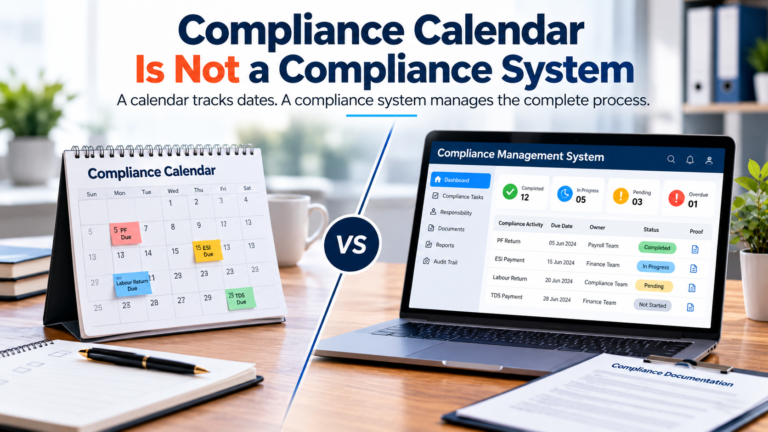
A compliance calendar can tell you when something is due. But it cannot tell you what exactly needs to be completed, who is responsible for it, whether the task has actually been completed, whether the required documents are available, whether the submission was made correctly, or whether the business can provide proof during an audit.
This is where many organisations misunderstand compliance management. A calendar is a reminder mechanism. A compliance system is a complete process for managing, executing, documenting and monitoring compliance activities.
For businesses managing payroll, labour laws, employee records and statutory requirements, this difference can be significant.
What Is a Compliance Calendar?
A compliance calendar is a tool used by businesses to track important compliance deadlines, recurring activities and statutory requirements.
It can help organisations remember when a compliance activity needs to be completed. However, a compliance calendar alone does not manage the entire compliance process.
A complete compliance management system should also identify:
- What needs to be completed
- When it needs to be completed
- Who is responsible
- Whether it has been completed
- Where the supporting evidence is stored
In simple terms: a compliance calendar tracks dates; a compliance system manages the process.
Why Is a Compliance Calendar Not Enough?
Businesses often use spreadsheets, calendars or reminders to track statutory and HR compliance activities. These tools are useful, but they generally focus on deadlines.
For example, a compliance tracker might show:
Statutory return – Due on 15th – Pending
But effective compliance management requires more information:
- What return needs to be filed?
- Which employees or establishment does it relate to?
- Who is responsible for preparing it?
- Who reviews it?
- Has it actually been submitted?
- Where is the acknowledgement?
- Where are the supporting documents stored?
Without this information, organisations may know that a deadline exists without having complete visibility of the compliance activity.
Compliance Calendar vs Compliance Management System
Compliance Calendar | Compliance Management System |
Tracks deadlines | Manages compliance activities |
Primarily answers “When?” | Answers “What, When, Who, Done and Proof?” |
Provides reminders | Assigns responsibility |
Lists recurring activities | Tracks execution and completion |
May show status | Maintains a complete audit trail |
Focuses on dates | Connects requirements, actions and evidence |
A calendar can therefore be one part of a compliance management system, but it should not be treated as the entire system.
The 5 Questions a Compliance System Should Answer
1. What Needs to Be Done?
Every organisation should first identify the compliance requirements that apply to it. These requirements can vary depending on factors such as business activity, location, number of employees, establishment type, industry, payroll structure, applicable registrations, and applicable labour and employment requirements. The first step is therefore not simply creating a list of dates. It is understanding which compliance activities actually apply to the organisation.
2. When Does It Need to Be Done?
Once requirements are identified, the organisation needs to track due dates, filing frequencies, payment deadlines, internal preparation dates, review dates and approval timelines. A good compliance process should provide enough time for preparation and review rather than waiting until the final deadline. This is particularly important when payroll and statutory activities are interconnected.
3. Who Is Responsible?
Every compliance activity should have a clearly identified owner.
Activity | Possible Owner |
Payroll processing | Payroll Team |
Employee records | HR Team |
Statutory payments | Finance Team |
Compliance filing | Compliance Team |
Final review | Designated Approver |
The exact responsibility will vary between organisations. The important principle is clear ownership. A deadline without an owner can easily become a missed deadline.
4. Is the Compliance Activity Actually Done?
A calendar entry should not automatically be treated as proof of completion. A stronger compliance workflow can use statuses such as:
Not Started → In Progress → Under Review → Completed
This gives HR, payroll, finance and management teams visibility into outstanding activities. It also helps identify issues before the actual compliance deadline.
5. Where Is the Proof?
Compliance management should not end when an activity is completed. The organisation should also be able to locate relevant evidence.
Depending on the requirement, documentation may include:
- Filing acknowledgements
- Payment records
- Challans
- Employee records
- Registers
- Supporting documents
- Approval records
- Compliance reports
Maintaining documentation creates a useful audit trail and makes it easier to demonstrate what was completed.
What Is a Compliance Management System?
A compliance management system is a structured process used to identify, assign, monitor, complete and document an organisation’s compliance obligations.
Unlike a simple compliance calendar, it connects the complete workflow:
Requirement → Deadline → Owner → Action → Review → Completion → Documentation → Evidence
This approach gives organisations greater visibility over their compliance activities.
How Does Compliance Management Help HR and Payroll Teams?
HR and payroll teams often manage activities that involve recurring deadlines, employee information and statutory requirements.
A structured compliance process can help teams:
- Organise recurring activities
- Assign responsibility
- Track pending tasks
- Monitor completion
- Maintain supporting documents
- Improve visibility for management
- Create a consistent record of completed activities
This becomes increasingly relevant as organisations grow or operate across multiple locations.
How to Build a Simple Compliance Management Process
Step 1: Identify Applicable Requirements
Create a list of compliance requirements relevant to the organisation.
Step 2: Create a Compliance Calendar
Record deadlines, frequencies and important preparation dates.
Step 3: Assign Ownership
Identify the person or team responsible for every activity.
Step 4: Track Completion
Use defined statuses to monitor pending and completed activities.
Step 5: Maintain Evidence
Store relevant acknowledgements, payment records and supporting documentation.
This transforms a simple deadline calendar into a more structured compliance workflow.
Compliance Management in India
For businesses operating in India, compliance management can involve multiple areas of HR, payroll, employment and statutory administration.
The exact requirements applicable to a business depend on factors such as its workforce, establishment, location, business activities and applicable registrations.
Because requirements can change and applicability can vary, organisations should maintain an appropriate process for reviewing their compliance obligations rather than relying only on an old checklist or calendar.
The objective is not simply to remember compliance dates. It is to maintain a repeatable process for identifying, completing and documenting applicable requirements.
What Should a Compliance Checklist Contain?
Field | Purpose |
Compliance Requirement | Identifies what needs to be done |
Frequency | Shows how often it occurs |
Due Date | Identifies the deadline |
Responsible Person | Establishes ownership |
Reviewer | Defines the review responsibility |
Status | Shows progress |
Completion Date | Records when it was completed |
Evidence | Identifies where proof is stored |
Remarks | Records relevant notes or exceptions |
This structure can help businesses move from deadline tracking to compliance management.
Compliance Calendar: Frequently Asked Questions
Is a compliance calendar the same as a compliance management system?
No. A compliance calendar primarily tracks deadlines and recurring activities. A compliance management system covers a broader workflow including requirements, ownership, execution, monitoring, completion and documentation.
What is the purpose of a compliance calendar?
The main purpose of a compliance calendar is to help organisations track important compliance dates and recurring activities so that deadlines are not overlooked.
What should a compliance management system include?
A compliance management system should typically include applicable requirements, deadlines, responsible owners, status tracking, review processes, completion records and supporting evidence.
Why is documentation important in compliance?
Documentation provides evidence of completed activities and helps organisations maintain an audit trail. It can also make it easier to retrieve information when compliance records need to be reviewed.
Who should manage compliance in a company?
Responsibility depends on the organisation’s structure. HR, payroll, finance, internal compliance teams or external service providers may handle different activities. The important point is that each requirement should have clear ownership.
Can a spreadsheet be used for compliance management?
Yes. A spreadsheet can be useful for organising compliance requirements, deadlines, owners and status. However, its effectiveness depends on how consistently the organisation updates it, assigns responsibility and maintains supporting documentation.
Quick Answer: What Is the Difference Between a Compliance Calendar and a Compliance System?
A compliance calendar tells you when a compliance activity is due. A compliance management system tells you what needs to be done, who is responsible, whether it was completed and where the supporting evidence is stored.
This is why a compliance calendar should be treated as one component of compliance management rather than the complete compliance system.
Final Takeaway
A compliance calendar is useful for tracking deadlines. But effective compliance management requires more than dates.
Businesses need a process that connects:
What? → When? → Who? → Done? → Proof?
When these five questions are clearly addressed, organisations can create a more structured approach to managing HR, payroll and statutory compliance activities.
The goal is not simply to remember a compliance deadline. The goal is to know what was required, who handled it, when it was completed and where the evidence is.
How Savi3HR Can Help
Managing HR, payroll and compliance activities can become increasingly complex as businesses grow.
Savi3HR Global Solutions provides HR, payroll, accounting and compliance-related solutions for businesses.
For organisations looking to create more structured HR and compliance processes, professional support can help improve visibility, accountability and documentation.
Contact Savi3HR to discuss your HR, payroll and compliance requirements.