
An employee reaches their six-month anniversary. Does reaching the probation end date automatically mean they are confirmed?
No. Completing a probation period does not replace a structured evaluation. Treating confirmation as merely a calendar reminder exposes companies to serious operational bottlenecks, culture mismatches, and significant legal risks such as deemed confirmation.
For HR leaders, employee confirmation is a pivotal milestone in the talent lifecycle. It requires assessing performance, gathering structured manager feedback, ensuring alignment with organizational values, and formally documenting the outcome.
Here is the step-by-step guide to managing employee probation reviews, mitigating legal exposure, and standardizing confirmation workflows.
What Is Employee Confirmation After Probation?
Employee confirmation is the formal, documented process where an organization approves and communicates its decision to transition an employee from probationary status to permanent employment.
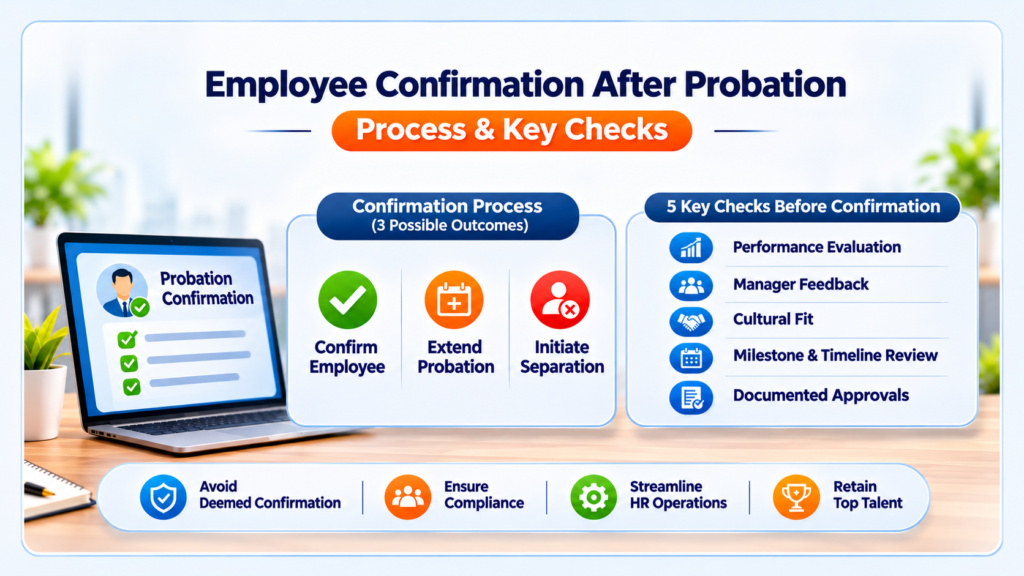
During probation—typically ranging from 3 to 6 months—both the employer and the employee assess mutual fit. At the end of this evaluation period, an organization generally takes one of three formal routes:
Confirm the employee: The individual has met or exceeded performance standards, and the company issues a formal confirmation letter.
Extend the probation period: Performance or behavioral concerns require additional observation, or an extended leave interrupted the original evaluation window.
Initiate separation: The employee has not demonstrated suitability for the role, leading to termination in accordance with contractual notice terms.
Probation completion and confirmation are distinct events. The date marks the end of an assessment window; confirmation is the executive decision that follows it.
The Hidden Risk: Deemed Confirmation
One of the costliest errors HR teams make is failing to act before a probation period expires.
In many jurisdictions and legal precedents (notably under Indian labor law, UK employment frameworks, and common law jurisdictions), silence or administrative inaction can trigger “deemed confirmation.”
What is Deemed Confirmation?
If an employer permits an employee to continue working past their probation end date without issuing an extension letter, a confirmation letter, or a notice of termination, courts or labor tribunals may interpret the employment as confirmed by default.
What Happens When Confirmation Lapses?
Loss of At-Will / Flexible Termination: Terminating a probationary employee generally requires shorter notice and lower evidentiary thresholds. Once deemed confirmed, the employee gains full statutory employment protections, making separation significantly more complex.
Audit & Compliance Gaps: Incomplete employee files cause friction during statutory HR audits and ISO compliance reviews.
Payroll & Benefits Confusion: Permanent employees often become eligible for revised compensation structures, retirement contributions, or medical coverage that remain stalled when records are unupdated.
5 Essential Checks Before Confirming an Employee
Before signing off on an employee confirmation letter, HR teams should systematically review five core areas:
1. Objective Performance Evaluation
Measure output against key performance indicators (KPIs) established during onboarding.
Did the employee achieve target deliverables?
Is work quality, accuracy, and deadline adherence consistent?
How quickly do they assimilate training and solve non-routine problems?
2. Structured Manager Feedback
Reporting managers observe daily work habits, peer collaboration, and problem-solving firsthand.
Collect feedback via a standardized rubric rather than open-ended emails.
Document specific strengths, development areas, and a concrete recommendation (Confirm, Extend, or Separate).
Ensure feedback is backed by objective work samples rather than subjective sentiment.
3. Cultural & Value Alignment
High technical performance paired with disruptive conduct damages team morale.
Does the employee adhere to internal conduct standards and company policies?
Do they communicate constructively with cross-functional stakeholders?
Do they show accountability when errors occur?
4. Milestone & Timeline Auditing
A proactive review starts weeks before the calendar deadline, not the day before.
30-Day Checkpoint: Initial review of onboarding and basic task execution.
60-Day Checkpoint: Mid-point assessment to flag gaps early and provide course correction.
75-Day Checkpoint (for a 90-day cycle): Manager feedback submission and HR evaluation.
Final Week: Approvals secured, decision letter prepared and signed.
5. Documented Approvals
Never finalize a confirmation verbally or through informal chat channels.
Ensure sign-offs from the direct manager, department head, and HR lead are captured in writing.
Archive the completed review form in the employee’s central file.
Operational Impact: Manual vs. Automated Probation Tracking
Tracking employee status in spreadsheets across multiple managers inevitably leads to missed deadlines and inconsistent standards.
Common Operational Bottleneck | Direct Impact on HR & Business | Automated HRMS Solution |
|---|---|---|
Delayed confirmation letters | Lowers employee trust; triggers legal exposure to deemed confirmation | Automated date-triggers initiate reviews 30 days prior to expiry |
Unresponsive managers | HR spends hours manually chasing evaluation forms | Scheduled notifications and auto-escalations to department heads |
Subjective evaluations | Discrepancies between departments in confirmation criteria | Standardized online review forms with mandatory objective scoring |
Incomplete personnel records | Delays payroll adjustments, benefits enrollment, and audit compliance | Automatic profile status update from “Probationer” to “Permanent” |
The HR Employee Confirmation Checklist
A standardized checklist ensures that HR teams, reporting managers, and leadership follow a consistent review framework before issuing any formal confirmation letter.
Phase 1: Pre-Review Audit (30 to 21 Days Before Due Date)
Verify Dates: Confirm joining date, probation duration, and contractual end date against the employment contract.
Milestone Check: Review earlier 30-day and 60-day check-in notes to see if previous performance flags were raised.
Initiate Evaluation: Trigger the standardized performance review form to the reporting manager at least 21 days before the probation deadline.
Phase 2: Evaluation & Internal Approvals (14 to 7 Days Before Due Date)
Review Manager Feedback: Ensure manager feedback includes concrete ratings and an explicit recommendation (Confirm, Extend, or Separate).
Assess Role Fit: Verify attendance, conduct, policy adherence, and alignment with core job responsibilities.
Secure Authorizations: Obtain formal sign-offs from the direct manager, department head, and HR head.
Phase 3: Communication & Record Updates (Final Week)
Issue Formal Decision Letter: Release the signed Confirmation Letter (or Extension Letter with revised KPIs) before the probation period lapses.
Update HRMS Records: Switch the employee’s status from Probationary to Permanent.
Adjust Payroll & Benefits: Notify the payroll team of any applicable salary increments, revised notice periods, or permanent benefit enrollments.
Frequently Asked Questions
1. Is employee confirmation automatic after completing probation?
Generally, no—unless the employment contract or local statutory law specifies automatic confirmation. However, if HR allows the probation date to lapse without any written decision or extension, tribunals may rule that the employee has achieved deemed confirmation by default.
2. Can an employer extend an employee’s probation period?
Yes, provided the employment agreement includes an extension clause. The extension must be documented in writing before the original probation period ends, detailing the reason for extension, specific performance expectations, and the revised end date.
3. What should HR do if a manager recommends not confirming an employee?
HR must verify that the manager provided clear expectations, constructive feedback, and reasonable time for improvement during the probation period. If separation is warranted, HR must review the employment contract, calculate contractual or statutory notice pay, and issue a formal separation notice prior to the probation end date.
4. How does an HRMS help with probation management?
An HRMS automates workflow triggers. It tracks milestone dates, sends automated review forms to managers, logs digital signatures, updates payroll statuses, and generates confirmation letters automatically upon sign-off.
Transform Your Confirmation Process
Employee confirmation should never be a frantic scramble at the end of the month. Establishing clear evaluation benchmarks, holding managers accountable to review timelines, and utilizing modern HRMS tools ensures that your company retains top talent while insulating itself from legal and administrative risks.
At Savi3 HR, we help growing companies streamline their talent lifecycles, automate probation workflows, and implement scalable HRMS solutions that minimize administrative overhead.