An employee’s details change. But have all the relevant records been updated?
A change in employee information may seem like a routine HR activity. However, it can affect much more than the employee database. It may also impact payroll processing, salary calculations, statutory records, employee benefits, and compliance reporting.
For example, a change in an employee’s salary structure may affect payroll calculations and applicable statutory contributions. An updated bank account may impact salary transfers, while a change in employment status may require updates across multiple HR and payroll systems.
This is why employee data management is an important part of payroll accuracy and statutory compliance.
Whenever employee information changes, HR and payroll teams must ensure that all relevant records are reviewed, updated, and validated.
What Is Employee Data Management in HR?
Employee data management is the process of collecting, maintaining, updating, verifying, and protecting employee information throughout the employment lifecycle.
It includes personal information, employment details, salary structures, bank information, attendance records, statutory identifiers, and other relevant employee records.
When an employee’s information changes, the update should not stop with the HR database. Every connected system and record that relies on that information should be reviewed.
For businesses, maintaining accurate employee master data helps ensure consistency across HR operations, payroll processing, and applicable statutory requirements.
Why Do Employee Data Changes Matter for Payroll and Compliance?
Employee information is used across multiple business processes.
A single update may influence:
Monthly salary calculations.
Employee tax deductions.
Applicable PF and ESI contributions.
Professional Tax and Labour Welfare Fund records, where applicable.
Bank salary transfers.
Employee benefits and eligibility.
Statutory registrations and reporting.
Payroll documentation and audit records.
If the information is updated in one system but not in another, inconsistencies can arise.
For example, an employee’s revised salary may be updated in the HRMS but not reflected in the payroll system. This could result in incorrect salary calculations or contribution amounts.
Therefore, employee data changes should trigger a review of all relevant records.
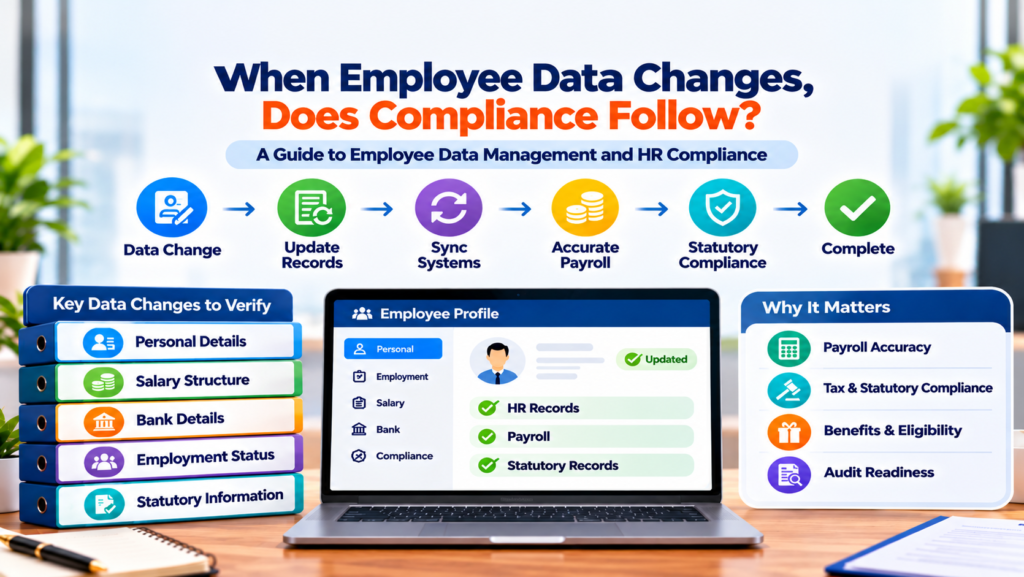
5 Important Employee Data Changes HR Teams Should Verify
1. Personal Details: Are Employee Records Updated?
Changes to an employee’s personal information should be reviewed and updated in the relevant records.
Examples include:
Change of name.
Change of address.
Updated contact information.
Changes to emergency contact details.
Corrections to employee identification information.
HR teams should verify the supporting information and determine whether the change needs to be reflected in payroll records, statutory portals, benefits documentation, or other relevant systems.
For example, a change of employee name may require updates to applicable employment records and statutory information to maintain consistency.
What HR should check: Are the updated personal details accurately reflected wherever they are required?
2. Salary Structure: Has Payroll Been Updated?
A salary revision can affect multiple payroll components.
Changes may include:
Basic salary.
House Rent Allowance (HRA).
Special allowances.
Other salary components.
Variable pay.
Total Cost to Company (CTC).
When a salary revision is approved, payroll teams should verify the revised salary structure, approval details, and effective date.
They should also assess whether the change affects applicable statutory contributions, salary TDS, and other payroll calculations.
If a salary revision is effective from an earlier date, the team may also need to calculate salary arrears.
What HR should check: Does the payroll system reflect the approved salary structure from the correct effective date?
3. Bank Details: Is the Updated Account Verified?
An employee may change their bank account during their employment.
If the updated details are not communicated to payroll, salary processing may be affected.
Before the next payroll cycle, teams should:
Collect the updated bank account details.
Verify the information through the organization’s approved process.
Update the relevant payroll records.
Confirm that the correct account is used for salary processing.
Maintain appropriate documentation and access controls.
Bank details are sensitive employee information and should be handled securely.
What HR should check: Have the revised bank details been verified and updated before salary processing?
4. Employment Status: Have All Systems Been Updated?
Employment status can change several times during an employee’s journey.
Examples include:
New employee joining.
Probation completion.
Employment confirmation.
Department transfer.
Location transfer.
Promotion.
Change in reporting manager.
Resignation or termination.
Retirement or other separation.
Each change may affect different HR and payroll processes.
For example, an employee transfer may require changes to the department, location, reporting structure, attendance configuration, or applicable state-specific compliance records.
Similarly, an employee exit may trigger final salary calculations, leave encashment, gratuity eligibility assessment, and full and final settlement activities.
What HR should check: Have all relevant employment status changes been communicated to payroll and other connected systems?
5. Statutory Records: Have Applicable Details Been Reviewed?
Certain employee data changes may require updates to statutory records, registrations, declarations, or filings.
Depending on the nature of the change and applicable requirements, HR and payroll teams may need to review:
Employees’ Provident Fund (EPF) records.
Employees’ State Insurance (ESI) records.
Professional Tax (PT) details.
Labour Welfare Fund (LWF) records.
Income tax declarations and payroll records.
Employee identification and registration details.
Relevant statutory filings and supporting documentation.
Not every employee data change requires an update to every statutory record. The applicable requirement depends on the type of information changed, employee eligibility, establishment coverage, and relevant statutory rules.
What HR should check: Have all affected statutory records and reporting requirements been reviewed and updated wherever necessary?
What Happens When Employee Data Is Not Updated?
Outdated employee information can create operational and compliance challenges.
Here are some common examples:
| Employee data issue | Possible impact |
|---|---|
| Incorrect salary structure | Incorrect salary or contribution calculations |
| Outdated bank details | Salary transfer failure or delay |
| Incorrect employee name | Inconsistent employment or statutory records |
| Missing joining or exit update | Incorrect payroll and eligibility records |
| Unrecorded employee transfer | Incorrect department or location reporting |
| Outdated tax information | Incorrect salary TDS calculations |
| Missing statutory updates | Inconsistent registration or filing information |
These issues may lead to payroll corrections, employee queries, reconciliation differences, and additional administrative work.
A structured employee data update process helps reduce these risks.
How to Maintain Accurate Employee Data Across HR and Payroll Systems
Businesses can improve employee data accuracy by establishing a consistent process for managing employee changes.
Step 1: Record Every Employee Change
Maintain a formal process for employees and authorized HR personnel to report changes in personal, employment, salary, and banking information.
Step 2: Verify the Supporting Information
Validate the relevant documents, approvals, and supporting information before updating employee records.
Step 3: Identify the Systems Affected
Determine whether the change affects the HRMS, payroll system, attendance system, employee benefits, statutory portals, or other relevant records.
Step 4: Update the Correct Information
Make the necessary updates in the relevant systems, ensuring that the approved information and effective dates are accurately recorded.
Step 5: Review Payroll Impact
Check whether the employee data change affects salary calculations, deductions, contributions, TDS, or other payroll components.
Step 6: Review Statutory Impact
Identify whether the change requires updates to applicable statutory registrations, declarations, contribution records, or filings.
Step 7: Maintain an Audit Trail
Keep supporting documents, approval details, previous and revised information where appropriate, and records of completed updates.
Step 8: Validate Before Payroll Closure
Before processing payroll, review relevant employee changes to ensure that the latest approved information is reflected correctly.
Why Effective-Dated Employee Records Are Important
Maintaining employee information is not only about knowing what changed. It is also about knowing when the change became effective.
This is known as effective-dated employee data management.
Consider an employee whose salary revision is approved on 15 August but is effective from 1 August.
The payroll team must distinguish between:
Approval date: 15 August.
Effective date: 1 August.
The approval date indicates when the change was authorized, while the effective date determines when the revised salary applies.
The same principle is important for employee transfers, promotions, confirmation, changes in employment status, and other HR activities.
Effective-dated records help payroll teams apply the correct employee information to the relevant payroll period and maintain a reliable history of changes.
How HRMS and Payroll Systems Help Manage Employee Data Changes
An HRMS can help businesses maintain employee information in a centralized environment. However, accurate data management also depends on the processes used to update and validate that information.
When HRMS, attendance, and payroll systems are connected through suitable workflows, employee changes can be communicated more consistently.
Businesses should consider:
Centralized employee master data.
Role-based access to employee information.
Approval workflows for employee changes.
Effective-date tracking.
Payroll input validation.
Employee change reports.
Data synchronization between systems.
Regular data reconciliation.
Even when different software platforms are used, a structured data-sharing process can help maintain consistency across HR and payroll operations.
Best Practices for Employee Data and Compliance Management
To maintain reliable employee records, organizations should follow these practices:
Establish a standardized employee information update process.
Assign responsibility for employee master data maintenance.
Verify changes before updating records.
Record approval and effective dates.
Communicate relevant changes to payroll on time.
Review statutory impact wherever applicable.
Maintain secure access to sensitive employee information.
Reconcile HRMS and payroll records regularly.
Maintain historical records and audit trails.
Conduct periodic employee data accuracy reviews.
A consistent approach helps businesses reduce manual errors and maintain better control over employee information.
Frequently Asked Questions (FAQs)
What is employee data management in HR?
Employee data management is the process of collecting, maintaining, verifying, updating, and protecting employee information throughout the employment lifecycle. It supports accurate HR records, payroll processing, reporting, and applicable compliance requirements.
Why is updating employee information important for payroll?
Employee information directly influences payroll calculations. Changes to salary, bank details, employment status, attendance, or other relevant information can affect salary payments, deductions, statutory contributions, and tax calculations.
What employee details should HR update when information changes?
HR teams should review personal details, contact information, bank details, salary structure, employment status, joining or exit dates, statutory identifiers, and other relevant employee records.
Does a salary revision affect statutory compliance?
It may. A salary revision can affect applicable PF, ESI, Professional Tax, TDS, and other payroll calculations, depending on the revised wage components, employee eligibility, establishment coverage, and applicable statutory provisions.
Does a bank account change require a payroll update?
Yes. When an employee changes their bank account, the updated details should be verified and reflected in the relevant payroll records before salary processing to reduce the risk of failed or delayed salary transfers.
What is effective-dated employee data?
Effective-dated employee data records the date from which an employee information change applies. For example, a salary revision approved in August may be effective from July. Recording both dates helps payroll teams calculate the correct salary for the relevant period.
What happens if HRMS and payroll records do not match?
Inconsistent records can result in incorrect salary calculations, contribution differences, reporting errors, and additional reconciliation work. HR and payroll teams should identify the differences, verify the approved information, and update the relevant systems.
How often should employee records be reviewed?
Employee records should be updated whenever an approved change occurs. Businesses should also conduct periodic reviews to identify outdated information, missing details, duplicate records, and inconsistencies across HR and payroll systems.
How can businesses improve employee data accuracy and compliance?
Businesses can improve employee data accuracy by implementing standardized update procedures, approval workflows, effective-date tracking, payroll validation, statutory reviews, and regular reconciliation between HRMS and payroll records.
Conclusion: One Employee Data Change Can Affect Multiple Systems
Employee information is constantly changing throughout the employment lifecycle.
A change in personal details, salary structure, bank account, or employment status may affect several connected HR, payroll, and statutory records.
That is why employee data management should never be treated as a simple database update.
Businesses need a structured process to verify every change, identify its impact, update relevant systems, and validate the information before payroll closure.
Accurate employee data supports accurate payroll. Accurate payroll supports stronger compliance.
At Savi3 HR, we understand the importance of maintaining reliable employee records and structured payroll processes.
Through our HR, payroll, accounting, and compliance services, we help businesses manage essential workforce operations with a focus on accuracy, process, and compliance.
Compliance Compass by Savi3 HR – Helping businesses stay compliant, organised & audit-ready.
Visit savi3hr.in to learn more about our HR, payroll, and compliance services.