
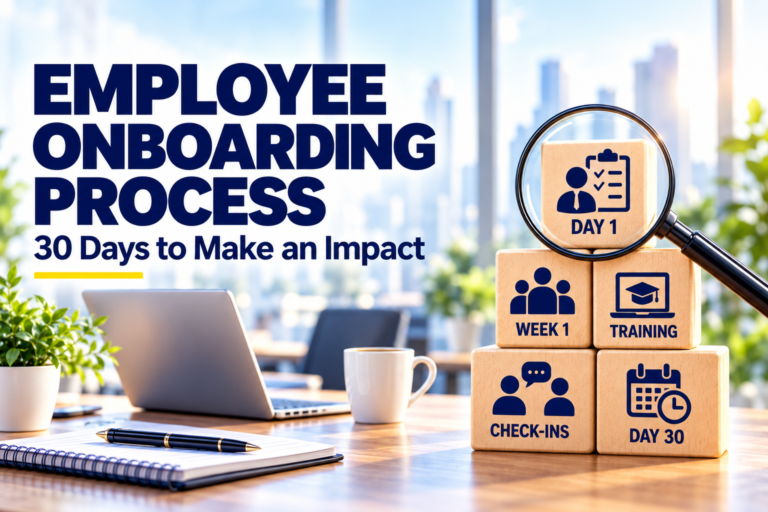
A new employee’s early weeks shape their perception of the role, the team, the organisation, and even their own expectations. An effective onboarding process must involve more than paperwork and a laptop — the first 30 days should provide access, clarity, training, support and feedback to help the employee settle in and contribute effectively.
An onboarding process usually begins before Day 1 and continues through the first few weeks, built around a structured set of milestones and regular manager check-ins. Most onboarding frameworks today use a variation of pre-boarding, Day 1, Week 1, and 30/60/90-day milestones.
What Is an Employee Onboarding Process?
An employee onboarding process refers to the process of helping a new employee settle into an organisation. From completing necessary paperwork to introducing the role, responsibilities, training and assessments, it typically includes:
- Pre-boarding
- Day 1 orientation
- Week 1 activities
- Role-specific training
- Initial assignments
- Manager check-ins
- 30-day feedback and review
The objective is not simply to complete joining formalities — it is to help the employee understand:
- What is my role?
- What is expected from me?
- Who should I work with?
- Which processes should I follow?
- Which tools do I need?
- How will my performance be measured?
Why Are the First 30 Days of Onboarding Important?
The first 30 days give a new employee a glimpse into the organisation’s culture and operations. A new employee may be exposed to several areas at once:
- Company culture
- Team and reporting structure
- Job responsibilities
- Internal processes
- Technology and systems
- Communication practices
- Performance expectations
Lack of clarity in these areas can lead employees to spend extra effort understanding basic processes. A structured onboarding programme creates a path that moves the employee from joining, to learning, to contributing, to receiving feedback — which is why many frameworks extend beyond Day 1 into a 30/60/90-day structure.
Employee Onboarding Checklist: Before Day 1
An onboarding process typically begins before the employee joins. HR and managers should ensure the following are in place so the employee walks in ready to be productive:
Category | Pre-Boarding Action Items |
Documentation | Offer and joining documents, employee records, payroll information |
System access | HRMS or employee portal access, email account, system and application access |
Equipment | Laptop or other required equipment |
Workplace readiness | Workplace information, reporting manager details |
Schedule & plan | First-day schedule, introduction plan, initial training schedule |
Day 1 Onboarding: Access and Introduction
The first day should orient the employee without overwhelming them. The goal of Day 1 is not to teach, but to orient the employee with the organisation, their team and their expectations.
Activity | What It Covers |
HR introduction | Explain the organisation, policies, procedures and HR-related information |
Team introduction | Introduce the employee to their team and important stakeholders |
Manager introduction | Manager explains the employee’s role, responsibilities and initial expectations |
Access | Ensure required email accounts, HR systems, communication tools and applications are set up |
Workplace orientation | For office-based employees, a tour of the workspace |
First-day expectations | A snapshot of what the employee should focus on in the first week |
Week 1: Build Role and Process Clarity
The first week should involve more than understanding the team — this is when the employee begins to understand the role within the organisation.
Step | Focus Area |
1 | Explain role responsibilities — clarity on primary responsibilities and expected outcomes |
2 | Introduce key processes — the workflows the employee will use regularly |
3 | Provide role-specific training — relevant to actual responsibilities, not just general information |
4 | Introduce key stakeholders — who to contact for approvals, information and collaboration |
5 | Set initial goals — realistic short-term objectives |
6 | Schedule manager check-ins — regular conversations to catch questions and blockers early |
The first week is not just an orientation, but the beginning of role clarity.
Days 8–30: Learning, Contribution and Support
Once the employee understands the basics, they can be supported to apply what they have learned. During this period, employees can begin handling:
- Small assignments
- Role-specific tasks
- Team responsibilities
- Process-based work
- Initial projects
- Cross-functional interactions
The level of responsibility should depend on the role and the employee’s experience. A new employee should have enough responsibility to begin contributing, but with accessible guidance when needed.
30-Day Onboarding Review
The 30-day review is an important checkpoint. Instead of simply asking “How are you?”, HR can hold a structured conversation across several areas:
Area | Key Question |
Role clarity | Does the employee understand their responsibilities? |
Training | Are there areas where additional training is required? |
Process understanding | Does the employee understand the team’s workflows? |
Team integration | Has the employee developed working relationships with relevant colleagues? |
Challenges | Are there any blockers affecting their work? |
Feedback | What is working well, and what could be improved? |
Next steps | What should the employee focus on during the next 30–60 days? |
This transforms onboarding from a one-day HR activity into a continuing process.
30-Day Employee Onboarding Checklist
Timeline | Focus | Key Activities |
Before Day 1 | Preparation | Documents, payroll setup, equipment, system access |
Day 1 | Introduction | HR orientation, team introduction, manager meeting |
Week 1 | Role clarity | Responsibilities, processes, tools and training |
Week 2 | Learning | Role-specific training and guided tasks |
Week 3 | Contribution | Initial assignments and collaboration |
Week 4 | Review | Feedback, challenges, progress and next goals |
Day 30 | Milestone | Structured onboarding review |
Common Employee Onboarding Mistakes
Even organisations with dedicated HR teams can experience gaps in onboarding.
Mistake | Why It Happens / What to Do Instead |
Treating onboarding as paperwork | Documentation is only part of onboarding — it should not be the whole process |
Too much information on Day 1 | New employees can get overwhelmed if every policy and process is presented at once |
No definition of responsibilities | Employees need to know what their role involves and what their manager expects |
Delaying system access | A new employee cannot begin work without the tools and access their role requires |
No regular check-ins | Without follow-up conversations, managers may find problems only after it’s too late to fix them |
Same onboarding plan for every role | A sales executive, developer, payroll specialist and HR manager need different onboarding experiences; keep the framework consistent but tailor the training and responsibilities |
How HR Can Improve the Employee Onboarding Process
A better onboarding process does not always require a complicated system. HR teams can start with five principles:
Principle | Description |
1. Prepare before joining | Ensure documentation, equipment and system access are ready |
2. Clear agenda for Day 1 | The employee should know the agenda for their first day |
3. Clarity during Week 1 | Explain responsibilities, workflows and expectations |
4. Continuous support | Don’t disappear after the employee’s first week |
5. Day 30 review | Use the first month’s experience to identify gaps and set the next priorities |
Employee Onboarding Process in India
In India, onboarding may also involve HR administration, payroll setup, employee records and statutory processes, such as:
- Employee documentation
- Payroll setup
- Attendance configuration
- Leave setup
- HRMS registration
- Employee records
- Applicable statutory registrations
- Company policy acknowledgement
- Benefits information
Exact requirements vary by employee, organisation, location and applicable laws. HR teams should ensure their checklist is relevant to their own organisation rather than a generic template.
30-60-90 Day Onboarding: What Comes After the First Month?
The first 30 days lay the groundwork. The next phases increase the employee’s responsibility and ownership.
Phase | Days | Focus Areas |
Learn | 1–30 | Company, team, role, processes, tools, initial training |
Contribute | 31–60 | Independent tasks, larger assignments, collaboration, improving role-specific skills, regular performance feedback |
Build Ownership | 61–90 | Greater responsibility, independent execution, performance expectations, long-term goals, development planning |
This provides a roadmap for managers and employees beyond the first week.
Frequently Asked Questions About Employee Onboarding
What is the employee onboarding process?
It refers to helping a new employee understand the organisation, role, team, workplace processes and expectations from joining through the initial months of employment.
What should happen during the first 30 days of onboarding?
The first 30 days should include access, role clarity, training, team integration, initial responsibilities, manager check-ins and a 30-day review.
What should HR do on an employee’s first day?
HR can complete essential joining formalities, share relevant policy information, confirm system and workplace access, introduce the employee to key people, and explain the onboarding schedule.
Why is a 30-day onboarding plan useful?
It gives employees and managers milestones to learn the role, complete initial training, begin meaningful work, and discuss progress.
Is employee onboarding only HR’s responsibility?
No. While HR typically coordinates administrative elements, managers and team members play an important role in explaining responsibilities, processes, collaboration and performance expectations.
Final Thoughts
An effective employee onboarding process goes beyond joining documents. It continues through the employee’s first days, first week and first month, providing a structured transition: Access → Introduction → Clarity → Training → Support → Feedback.
When these elements are planned properly, the first 30 days become far more than an orientation period — they become the foundation for how employees understand their role and contribute to the organisation.