An employee’s last working day is confirmed. Is their final salary ready?
Not always.
When an employee resigns, retires, or leaves an organization, HR and payroll teams must complete more than just the final month’s salary calculation.
They need to review outstanding payments, applicable deductions, leave encashment, notice pay, pending incentives, reimbursements, and other eligible benefits.
This process is known as Full & Final Settlement (F&F).
A properly managed F&F settlement ensures that employees receive their eligible dues, employers maintain accurate payroll records, and the employee exit process is completed in an organized manner.
In India, Full & Final settlement also requires attention to applicable labour laws, statutory payment timelines, and employee-specific entitlements.
One missed component can result in an incorrect settlement, employee disputes, or delayed closure.
What Is Full & Final Settlement (F&F)?
Full & Final Settlement is the process of calculating and clearing the outstanding financial dues between an employer and an employee when the employment relationship ends.
It generally includes salary payable up to the last working day, eligible leave encashment, pending incentives, reimbursements, notice pay, applicable deductions, and other eligible benefits.
The exact settlement depends on the employee’s employment terms, company policies, applicable statutory requirements, and circumstances of separation.
The objective is simple: ensure that all payable and recoverable amounts are accurately identified, calculated, documented, and settled.
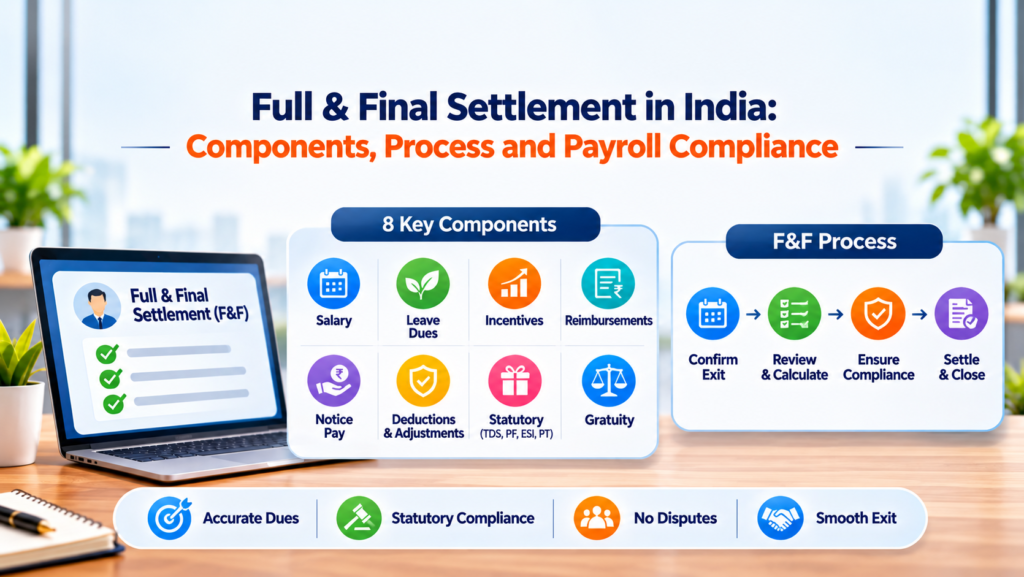
What Are the 8 Key Components of Full & Final Settlement?
A complete F&F calculation should cover all applicable employee payments, benefits, and authorized recoveries.
1. Salary Payable Up to the Last Working Day
The employee is entitled to salary for the eligible days worked during the final payroll period.
For example, if an employee’s last working day is 15 August, payroll must calculate the salary payable for the eligible period up to that date.
The calculation should consider the applicable salary structure, attendance, and payroll rules.
2. Unpaid Leave and Applicable Deductions
Payroll teams should review attendance records, unpaid leave, and other applicable deductions before finalizing the settlement.
Any deduction must be supported by applicable law, employment terms, or a valid company policy.
3. Eligible Leave Encashment
Employees may be entitled to payment for eligible accumulated and unused leave at the time of separation.
The number of eligible leave days and the calculation method depend on applicable legal provisions, employee category, state-specific requirements, and company policy.
HR teams should verify the leave balance and applicable encashment rules before processing the amount.
4. Notice Pay Recovery or Payment
Notice pay may arise when an employee does not serve the complete required notice period or when the employer releases the employee without requiring the full notice period.
Depending on the employment contract and applicable requirements, the settlement may include:
Notice pay recovery from the employee, where lawfully applicable.
Notice pay payable to the employee, where applicable.
Adjustment for the notice period already served.
Any approved notice-period waiver.
The calculation should be consistent with applicable employment terms and legal requirements.
5. Pending Incentives and Variable Pay
Employees may have outstanding performance incentives, commissions, bonuses, or variable compensation at the time of exit.
HR and payroll teams should verify the employee’s eligibility, performance conditions, approval status, and applicable payment policy.
Amounts already earned or otherwise legally payable should be treated according to the relevant terms and requirements.
6. Pending Reimbursements
Outstanding business expense claims should also be reviewed.
Examples include:
Travel expenses.
Business-related accommodation.
Approved conveyance expenses.
Other eligible business reimbursements.
The payroll or finance team should verify supporting documents and approval status before processing payment.
7. Applicable Statutory Deductions and Adjustments
Before closing the settlement, review applicable payroll deductions and statutory adjustments.
These may include:
Income tax or salary TDS adjustments.
Applicable provident fund contributions.
ESI contributions, where applicable.
Professional Tax, where applicable.
Other authorized deductions and recoveries.
The final calculation should follow relevant statutory provisions and employee eligibility conditions.
8. Gratuity, Where Applicable
Gratuity is an important employee benefit that should be reviewed during the exit process.
HR and payroll teams should check whether the employee is eligible for gratuity under the applicable statutory provisions and ensure that the eligible amount is assessed separately.
The eligibility, calculation, and payment should be handled according to the applicable gratuity rules and statutory timelines.
Gratuity should not be overlooked when preparing the employee’s final settlement.
What Is the Full & Final Settlement Process?
A structured F&F process helps HR and payroll teams avoid missed payments, incorrect deductions, and unnecessary delays.
Follow this checklist:
Step 1: Confirm the Last Working Day
Verify the employee’s resignation acceptance, separation approval, and confirmed last working day.
Step 2: Validate Attendance and Leave Records
Review attendance, unpaid leave, leave balances, and the employee’s eligible working days.
Step 3: Calculate Final Salary
Calculate salary payable up to the last working day based on the applicable salary structure and payroll rules.
Step 4: Review Pending Payments
Check incentives, variable pay, reimbursements, bonus eligibility, and other outstanding amounts.
Step 5: Calculate Notice Pay
Verify the notice period served, applicable recovery, or payment due under the employment terms.
Step 6: Verify Applicable Statutory Deductions
Calculate applicable tax, provident fund, ESI, Professional Tax, and other authorized adjustments.
Step 7: Check Gratuity Eligibility
Review whether the employee qualifies for gratuity and ensure that the applicable entitlement is considered.
Step 8: Prepare the Final Settlement Statement
Consolidate all payable amounts and recoveries into a transparent settlement statement.
Step 9: Process Payments Within Applicable Timelines
Ensure that wages and other statutory dues are paid within their respective legal deadlines.
Step 10: Complete Documentation and Closure
Maintain the final settlement statement, payment records, relevant approvals, and exit documentation.
What Is the Time Limit for Full & Final Settlement in India?
Payroll teams should distinguish between wages payable on separation and other F&F components because different statutory timelines may apply.
Under Section 17(2) of the Code on Wages, 2019, wages payable to an employee who resigns, is removed or dismissed, or is retrenched must be paid within two working days of the relevant separation event.
Gratuity has a separate statutory timeline under the Code on Social Security, 2020.
Therefore, employers should not assume that every component of Full & Final settlement follows the same payment deadline.
The applicable provisions, rules, and state-specific requirements should be reviewed when determining the timeline for each component.
Common Full & Final Settlement Mistakes HR Teams Should Avoid
Even a well-established payroll process can experience errors during employee exits.
Common mistakes include:
Using the wrong last working day for salary calculations.
Missing eligible leave encashment.
Incorrect notice pay recovery.
Overlooking pending incentives or reimbursements.
Not reviewing applicable gratuity eligibility.
Missing applicable statutory deductions.
Applying the same payment deadline to every settlement component.
Failing to maintain supporting calculation records.
Delaying payment due to incomplete internal clearance processes.
A standardized exit checklist and proper payroll validation can help reduce these risks.
Why Is Accurate F&F Settlement Important for Businesses?
Accurate final settlement is important for both employees and employers.
Better Employee Experience
A timely and transparent settlement helps employees understand their final payments and reduces unnecessary follow-ups.
Improved Payroll Accuracy
A structured calculation ensures that salary, leave encashment, incentives, reimbursements, and other applicable components are properly considered.
Stronger Compliance Management
Following applicable statutory requirements helps businesses manage wage payments, employee benefits, deductions, and documentation more effectively.
Reduced Employee Disputes
Clear calculations and supporting records help resolve questions about final payments and deductions.
Organized Employee Exit Management
A defined F&F process connects HR, payroll, finance, and administration teams, helping ensure a more organized employee separation.
Frequently Asked Questions (FAQs)
What is Full & Final Settlement in payroll?
Full & Final Settlement is the process of calculating and paying an employee’s outstanding dues when employment ends. It may include final salary, eligible leave encashment, notice pay, incentives, reimbursements, gratuity where applicable, and authorized deductions.
What are the components of Full & Final Settlement?
The common components include:
Salary payable up to the last working day.
Unpaid leave and applicable deductions.
Eligible leave encashment.
Notice pay recovery or payment.
Pending incentives and variable pay.
Pending reimbursements.
Applicable statutory deductions and adjustments.
Gratuity, where applicable.
What is the time limit for Full & Final settlement in India?
Under Section 17(2) of the Code on Wages, 2019, wages payable on resignation, removal, dismissal, or retrenchment must be paid within two working days of the relevant event. Other F&F components may have separate applicable statutory or contractual timelines.
Is leave encashment included in Full & Final Settlement?
Eligible unused leave may be encashed at the time of separation. The applicable entitlement and calculation depend on relevant labour laws, employee category, state-specific requirements, and company policy.
Can an employer deduct notice pay from Full & Final Settlement?
Notice pay recovery may be applicable when an employee does not serve the required notice period, subject to employment terms and applicable legal requirements. The calculation and recovery must be properly supported and lawful.
Is gratuity part of Full & Final Settlement?
Gratuity should be assessed as part of the employee exit process wherever applicable. Eligible employees must receive the benefit according to the applicable statutory provisions and payment timelines.
Can Full & Final Settlement be delayed because company assets have not been returned?
Internal clearance and asset recovery should be handled separately from statutory payment obligations. Employers should not assume that pending clearances automatically extend statutory deadlines for payment of wages. Any recovery or deduction must be legally permissible.
Conclusion: The Final Payroll Calculation Deserves the Same Attention as Every Monthly Run
An employee’s last working day marks the end of their employment, but it also triggers important HR, payroll, and compliance responsibilities.
Full & Final Settlement requires careful verification of salary payable, leave encashment, notice pay, incentives, reimbursements, gratuity where applicable, and other authorized deductions.
Missing even one component can lead to incorrect calculations, employee dissatisfaction, or compliance issues.
A structured F&F process helps businesses close employee records accurately, make payments within applicable timelines, and maintain reliable payroll documentation.
At Savi3 HR, we believe that payroll accuracy should continue until the employee’s final settlement is complete.
Our HR, payroll, accounting, and compliance services help businesses manage payroll operations and employee separation processes with structured workflows and compliance-focused support.
Visit savi3hr.in to learn more about our services and simplify your payroll and compliance operations.