
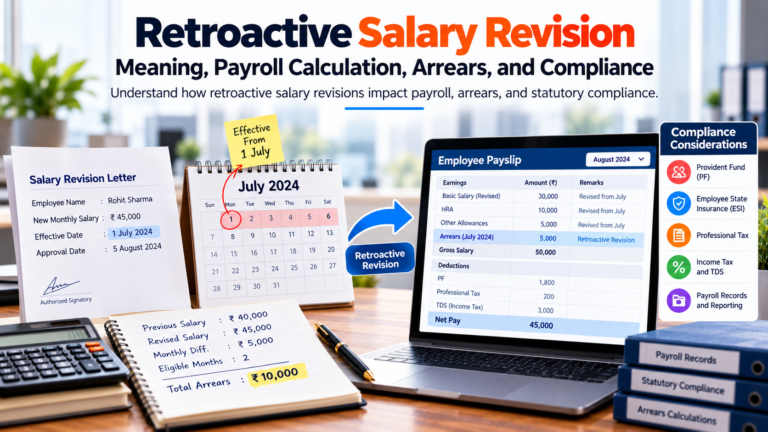
A salary revision may be approved today, but its effective date can be earlier. This is known as a retroactive salary revision, and it can directly impact payroll calculations, salary arrears, and statutory compliance.
For example, if an employee’s salary revision is effective from 1 July but approved in August, the payroll team may need to calculate the salary difference for July and pay the outstanding amount as arrears.
Understanding how retroactive salary revisions work helps businesses maintain accurate payroll records, ensure employees receive the correct salary, and reduce payroll compliance risks.
What Is a Retroactive Salary Revision?
A retroactive salary revision is a change in an employee’s salary that is approved on a particular date but takes effect from an earlier date.
The revised salary applies from the specified effective date, even if the approval or implementation happens later. As a result, payroll teams may need to recalculate salary payments for the affected period and pay the difference as salary arrears.
In simple terms: If a salary increase is effective from July but approved in August, the additional salary payable for July may be treated as arrears and included in the appropriate payroll cycle.
How Does Retroactive Salary Revision Work?
Consider an employee whose monthly salary increases from ₹40,000 to ₹45,000, effective 1 July. However, the revision is approved only in August.
The payroll team must determine the salary difference for July and account for it in the August payroll or another appropriate payroll cycle.
| Particulars | Amount |
|---|---|
| Previous monthly salary | ₹40,000 |
| Revised monthly salary | ₹45,000 |
| Effective date | 1 July |
| Approval month | August |
| Monthly salary difference | ₹5,000 |
| Illustrative July arrears | ₹5,000 |
In this example, the employee is entitled to an additional ₹5,000 for July, assuming a full eligible month and no other adjustments.
The ₹5,000 represents the illustrative gross salary difference before applicable deductions, tax treatment, or other payroll adjustments. The actual amount payable may vary depending on the salary structure, eligibility rules, and applicable statutory requirements.
How to Calculate Salary Arrears After a Retroactive Revision
Accurate arrears calculation is an essential part of retroactive salary processing.
The basic calculation is:
Salary Arrears = Revised Salary for the Eligible Period − Salary Already Paid for That Period
For a simple monthly salary revision, the calculation can be expressed as:
Monthly Arrears = Revised Monthly Salary − Previous Monthly Salary
For example:
Previous monthly salary: ₹40,000
Revised monthly salary: ₹45,000
Monthly difference: ₹5,000
Number of eligible previous months: 2
Total illustrative gross arrears = ₹5,000 × 2 = ₹10,000.
For partial months, multiple salary changes, unpaid leave, or changes in salary components, the payroll team must apply the relevant company policy and payroll calculation rules rather than simply multiplying the monthly difference.
Key Factors to Check Before Processing Retroactive Salary
Before processing a retroactive salary revision, payroll teams should verify the following:
1. Effective Date
Confirm the date from which the revised salary applies. The effective date determines the period for which salary needs to be recalculated.
2. Revised Salary Structure
Verify the approved revised salary, including applicable basic salary, allowances, and other compensation components. Changes to individual components may affect payroll calculations differently.
3. Previous Salary Payments
Review the salary already paid during the affected period to identify the exact difference payable to the employee.
4. Arrears Calculation
Calculate the arrears for each eligible payroll period. Consider partial months, unpaid leave, attendance adjustments, and other relevant factors wherever applicable.
5. Statutory and Tax Impact
Assess whether the revision affects applicable payroll deductions, provident fund contributions, Employee State Insurance contributions, professional tax, income-tax withholding, or other statutory calculations, depending on the employee’s eligibility and the applicable rules.
6. Payroll Records and Payslip
Record the salary revision, effective date, approval details, and arrears separately where appropriate. Ensure the payslip and payroll reports accurately reflect the adjustments.
How Does Retroactive Salary Revision Affect Payroll Compliance in India?
In India, retroactive salary revisions may affect more than the employee’s take-home pay. Depending on the salary components, employee eligibility, establishment coverage, and applicable rules, the revision may also affect statutory calculations and payroll reporting.
Payroll teams should review:
Provident Fund (PF): Determine whether the revised salary affects applicable contribution calculations and whether any adjustments are required.
Employee State Insurance (ESI): Assess the impact, where applicable, based on the relevant wage definitions and eligibility requirements.
Professional Tax: Check the applicable state rules and whether the revised payroll figures change the required deduction.
Income Tax and TDS: Evaluate the tax treatment of salary arrears and make any necessary withholding or reporting adjustments.
Payroll documentation: Maintain approval records, salary revision letters, arrears calculations, and supporting payroll entries.
Not every salary revision affects every statutory component in the same way. Employers should assess each adjustment against the rules applicable to the relevant payroll period and employee.
Common Mistakes to Avoid in Retroactive Salary Processing
Errors in retroactive salary processing can lead to incorrect payments, employee queries, and compliance issues.
Common mistakes include:
Using the approval date instead of the approved effective date.
Missing one or more eligible previous payroll periods.
Calculating arrears without reviewing salary already paid.
Ignoring changes to allowances or other salary components.
Overlooking applicable statutory contribution or tax adjustments.
Failing to document the approval and calculation.
Not communicating the arrears amount and relevant period to the employee.
A structured payroll review process can help reduce these errors and improve payroll accuracy.
Best Practices for Managing Retroactive Salary Revisions
Businesses can manage retroactive salary revisions more effectively by following a consistent process.
Obtain documented approval for the salary revision.
Confirm the effective date and revised salary structure.
Identify all affected payroll periods.
Recalculate salary for each eligible period.
Deduct salary amounts already paid from the recalculated entitlement.
Review applicable statutory contributions, tax withholding, and payroll reporting requirements.
Validate the arrears calculation before processing payment.
Update payroll records and communicate the adjustment to the employee.
Using a reliable payroll process helps organizations manage salary revisions accurately while maintaining transparent and consistent employee compensation records.
Frequently Asked Questions (FAQs)
What is retroactive salary revision?
Retroactive salary revision is a salary change approved on a particular date but effective from an earlier date. It may require an employer to recalculate previous salary payments and pay the difference as arrears.
What are salary arrears in payroll?
Salary arrears are amounts owed to an employee for a previous period. In a retroactive salary revision, arrears commonly represent the difference between the revised salary applicable to an earlier period and the salary already paid for that period.
How are arrears calculated after a salary increase?
Arrears are generally calculated by subtracting the salary already paid from the revised salary payable for the eligible period. The calculation may require adjustments for partial months, salary components, leave, deductions, and applicable payroll rules.
If a salary revision is approved in August but effective from July, should July arrears be paid?
If the approved revision applies from 1 July and the employee is eligible for the full month, the employer generally needs to account for the July salary difference. The payment timing and payroll treatment depend on the applicable company policy, employment terms, and relevant legal requirements.
Does retroactive salary revision affect PF and ESI?
It can. The impact depends on the applicable statutory rules, wage definitions, employee eligibility, and the components included in the revision. Payroll teams should evaluate the relevant requirements before processing adjustments.
Is retroactive salary revision the same as a salary increment?
No. A salary increment is an increase in compensation. A retroactive salary revision refers to a salary change that takes effect from an earlier date than its approval or implementation. A retroactive revision may include an increment, but the terms are not interchangeable.
How can companies avoid errors in retroactive payroll calculations?
Companies can reduce errors by verifying the effective date, reviewing previous salary payments, calculating arrears period by period, checking statutory implications, maintaining approval records, and validating the final payroll entries.
Conclusion
A retroactive salary revision is more than a change in an employee’s monthly salary. It requires accurate calculations for the applicable period, proper arrears processing, and a review of relevant payroll and statutory requirements.
When a salary revision is approved after its effective date, payroll teams must ensure that the difference is calculated correctly and reflected in the appropriate payroll records.
In payroll, the effective date can change the calculation. Getting it right helps businesses pay employees accurately, maintain transparent records, and manage compliance more effectively.
Looking for reliable payroll processing and compliance support? Savi3 HR helps businesses streamline payroll operations with a focus on accuracy, process, and compliance.
Visit savi3hr.in to learn more about our HR, payroll, accounting, and compliance services.