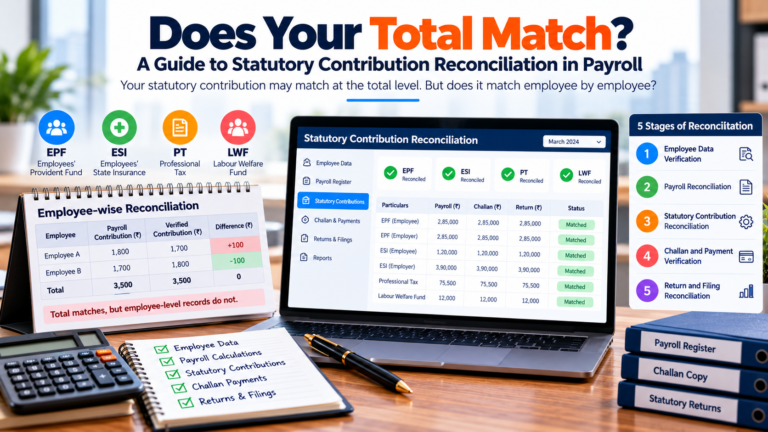
Your statutory contribution may match at the total level. But does it match employee by employee?
In payroll compliance, matching the final contribution total is not enough. Businesses must also ensure that employee data, payroll calculations, statutory contributions, challan payments, and returns are consistent with one another.
A total figure can look correct while an individual employee’s contribution remains incorrect.
Statutory contribution reconciliation is the process of verifying that payroll records, employee-level contribution calculations, payments, and statutory filings accurately match. It helps organizations identify discrepancies, reduce payroll errors, and maintain reliable compliance records.
For businesses in India, this process may involve applicable statutory components such as Employees’ Provident Fund (EPF), Employees’ State Insurance (ESI), Professional Tax (PT), and Labour Welfare Fund (LWF), depending on the establishment, employee eligibility, and applicable rules.
What Is Statutory Contribution Reconciliation?
Statutory contribution reconciliation is the process of comparing employee records, payroll calculations, statutory contribution amounts, payment records, and filed returns to identify and resolve discrepancies.
It involves more than comparing two totals. Payroll and compliance teams must verify that the correct amounts have been calculated and recorded for the relevant employees and payroll periods.
For example, a company’s payroll report and statutory payment records may show the same overall contribution amount. However, one employee may have an incorrect contribution while another employee’s record contains an offsetting error.
The total may match, but the employee-level records do not.
That is why employee-wise reconciliation is essential for accurate payroll compliance.
Why Is Matching the Total Not Enough?
A matching total provides only part of the picture. It does not automatically confirm that every employee’s contribution has been calculated correctly.
Consider this simplified example:
| Employee | Payroll contribution | Verified contribution | Difference |
|---|---|---|---|
| Employee A | ₹1,800 | ₹1,700 | +₹100 |
| Employee B | ₹1,700 | ₹1,800 | -₹100 |
| Total | ₹3,500 | ₹3,500 | ₹0 |
In this example, the overall totals match at ₹3,500. However, both employee records contain a ₹100 discrepancy.
The errors offset each other at the total level, making the reconciliation appear correct when only aggregate figures are reviewed.
This illustrates an important principle: a correct total does not necessarily mean correct employee-level compliance.
The figures above are illustrative and do not represent statutory contribution rates or a specific statutory calculation method.
The Five Stages of Statutory Contribution Reconciliation
A structured reconciliation process should follow the complete flow of employee and payroll information.
1. Employee Data Verification
Begin by verifying the employee information used for payroll and statutory calculations.
Depending on the applicable contribution, this may include:
Employee identification and relevant statutory identifiers.
Date of joining and exit, where applicable.
Eligible wages and relevant salary components.
Employee eligibility and coverage status.
Changes to employee records during the payroll period.
Incorrect or outdated employee data can affect contribution calculations and statutory reporting.
2. Payroll Reconciliation
Compare the payroll register with the employee information and contribution calculations.
Check whether the correct salary components, applicable wage definitions, eligibility criteria, and relevant payroll adjustments have been considered.
Also review additions, exits, salary revisions, unpaid leave, and other changes that may affect the relevant contribution period.
3. Statutory Contribution Reconciliation
Verify that employee-wise and employer-wise contributions have been calculated according to the applicable statutory rules.
For EPF and ESI, for example, the applicable wage definitions, contribution rates, eligibility conditions, limits, and effective dates must be considered where relevant.
Professional Tax and Labour Welfare Fund may involve different state-specific requirements and periodicity.
A reliable reconciliation should validate the underlying calculations rather than assume that matching totals prove correctness.
4. Challan and Payment Verification
Compare the contribution amounts payable with the relevant challan and payment records.
Verify the applicable period, payment amount, payment status, and available transaction or acknowledgement references.
Where differences exist, determine whether they arise from calculation errors, payment adjustments, outstanding amounts, or recording issues.
A generated challan alone does not necessarily establish that payment has been completed successfully.
5. Return and Filing Reconciliation
Compare the relevant statutory return or filing data with the reconciled payroll and contribution records.
Check employee-level details, contribution amounts, reporting periods, and relevant filing acknowledgements.
If a discrepancy is identified, determine the appropriate correction or amendment process under the applicable statutory requirements.
Completing this step helps establish consistency between payroll calculations, contribution payments, and statutory reporting.
Common Reasons for Employee-Level Contribution Mismatches
Contribution discrepancies can arise even when payroll processes appear to be working normally.
Common causes include:
Incorrect or incomplete employee information.
Differences between payroll and statutory wage definitions.
Incorrect eligibility or coverage classification.
Salary revisions not reflected in the relevant payroll period.
Joining or exit dates recorded incorrectly.
Errors in employee-wise contribution calculations.
Differences between payroll registers and challan amounts.
Incorrect employee identifiers or reporting details.
Manual adjustments not updated consistently across systems.
Return data that does not reflect the final reconciled payroll figures.
Identifying the source of a discrepancy is important because correcting only the total may leave the underlying employee record inaccurate.
How to Perform Employee-Wise Statutory Reconciliation
Organizations can improve reconciliation accuracy by following a consistent checklist.
Step 1: Identify the reconciliation period. Confirm the payroll month and relevant statutory reporting period.
Step 2: Collect the source records. Gather employee master data, payroll registers, contribution reports, challans, payment confirmations, and return records, as applicable.
Step 3: Match employee identifiers. Ensure that the same employee can be correctly identified across the relevant records.
Step 4: Verify contribution calculations. Review eligible wages, applicable contribution rules, and employee-wise amounts.
Step 5: Compare totals and individual records. Check both aggregate figures and employee-level differences.
Step 6: Investigate mismatches. Categorize differences by cause, such as employee data, payroll calculation, payment, or return reporting.
Step 7: Correct and document discrepancies. Make authorized corrections and maintain supporting calculations, approvals, and evidence.
Step 8: Complete final validation. Confirm that the corrected payroll records, applicable payment records, and statutory filings are consistent.
This approach makes reconciliation more systematic and creates a clearer audit trail.
EPF, ESI, PT, and LWF: What Should Payroll Teams Check?
The exact reconciliation requirements depend on the applicable law, establishment coverage, employee eligibility, and reporting period.
| Compliance area | Key reconciliation checks |
|---|---|
| EPF | Applicable wage components, eligibility, employee and employer contributions, relevant statutory records, challan, and return details |
| ESI | Applicable wage definitions, coverage and eligibility, contribution calculations, payment records, and filing details |
| Professional Tax (PT) | Applicable state rules, employee applicability, deduction amounts, payment records, and reporting requirements where relevant |
| Labour Welfare Fund (LWF) | Applicable state provisions, employee and employer contributions where required, contribution frequency, payment records, and filings where applicable |
These checks should not be treated as identical across all statutory components. Each has its own applicable rules, calculation methods, and reporting requirements.
Payroll teams should validate the requirements relevant to their establishment and employee population.
Best Practices for Accurate Payroll Compliance
To improve statutory contribution reconciliation, businesses should:
Maintain accurate and updated employee master data.
Use consistent employee identifiers across systems.
Reconcile employee-level amounts as well as overall totals.
Maintain clear records of salary changes and effective dates.
Separate payroll calculation, payment verification, and filing validation.
Investigate discrepancies before closing the compliance period.
Maintain supporting evidence for corrections and approvals.
Use standardized reconciliation reports and controlled workflows.
Review recurring mismatches to identify process weaknesses.
Restrict access to sensitive employee and payroll information.
Where payroll systems support automated reconciliation, organizations can use exception reports to identify mismatches more efficiently. However, automated matching should be supported by validation of the underlying calculations and records.
Frequently Asked Questions (FAQs)
What is statutory contribution reconciliation?
Statutory contribution reconciliation is the process of verifying that employee data, payroll calculations, statutory contribution amounts, challan payments, and return records are consistent for the relevant period.
Why is employee-wise reconciliation important?
Employee-wise reconciliation helps identify errors that may be hidden when only overall totals are compared. It verifies whether contributions are correctly calculated and recorded for individual employees.
Can statutory contribution totals match even when errors exist?
Yes. If an overstatement in one employee’s record offsets an understatement in another employee’s record, the overall total can match even though both individual records are incorrect.
What records are required for payroll statutory reconciliation?
Depending on the statutory component, payroll teams may need employee master data, payroll registers, wage and contribution reports, challans, payment confirmations, statutory return records, and relevant supporting documents.
Which statutory contributions should be reconciled in India?
Depending on applicability, organizations may need to reconcile EPF, ESI, Professional Tax, Labour Welfare Fund, and other relevant statutory payroll obligations. The requirements differ according to applicable laws and establishment circumstances.
How often should statutory contributions be reconciled?
A practical approach is to reconcile payroll and applicable statutory contributions for each relevant payroll or reporting period, before finalizing payments and filings wherever possible. Additional reviews may be needed when corrections, employee changes, or discrepancies arise.
What should a payroll team do if the total matches but employee records do not?
The team should identify the affected employees, verify the underlying payroll and statutory calculations, investigate the cause of each difference, make authorized corrections, and validate the relevant payment and filing records.
Conclusion: Compliance Is About Accuracy at the Employee Level
A matching statutory contribution total is a useful checkpoint, but it is not the final proof of payroll accuracy.
Reliable compliance requires a complete reconciliation process that connects employee data, payroll, statutory contributions, challan payments, and returns. Reviewing both totals and employee-level records helps organizations identify hidden discrepancies and maintain more reliable payroll documentation.
Compliance is not only about totals. It is about accuracy at the employee level.
At Savi3 HR, we understand the importance of structured payroll processes, accurate records, and compliance-focused workflows. Our HR, payroll, accounting, and compliance services help businesses strengthen their operational processes.
Visit savi3hr.in to learn more about our services.